


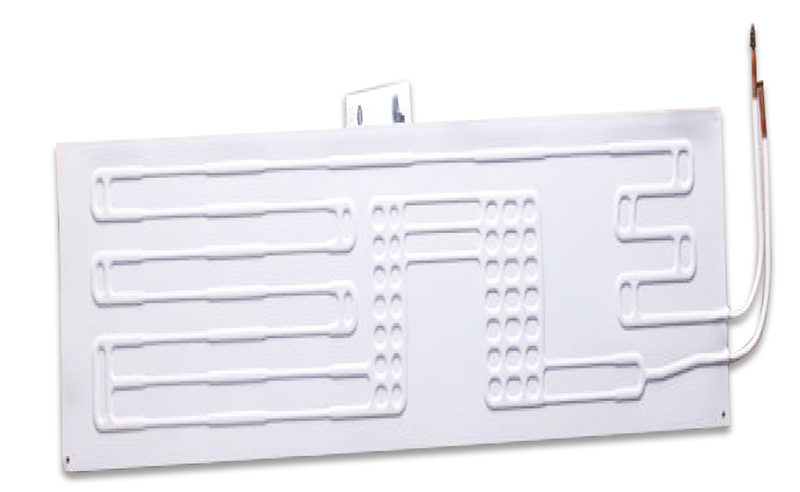
In the vapor-compression refrigeration cycle of refrigerators, the evaporator is the core component that fundamentally determines overall cooling efficiency, temperature stability, and energy consumption. While the compressor provides circulating power, the evaporator undertakes all heat absorption and heat exchange work. The upper limit of a refrigerator’s cooling performance is completely defined by the evaporator’s thermodynamic design.
1. UA Value Determines Basic Cooling Capacity
The overall thermal conductance (UA value) is the core quantitative standard for evaporator performance. Based on the LMTD heat transfer principle, a higher UA value reduces heat transfer temperature difference and exergy loss, making the refrigeration cycle closer to the ideal Lorenz cycle.
High-efficiency evaporators improve material thermal conductivity and structural compactness to increase UA performance, delivering greater effective cooling capacity under the same compressor power, directly upgrading the refrigerator’s cooling speed and basic efficiency.
2. Refrigerant Distribution Uniformity Determines Actual Efficiency Utilization
Refrigerant maldistribution is the key hidden factor causing efficiency attenuation. Unoptimized flow channels lead to partial overheating, liquid accumulation and dry patches, reducing the effective heat exchange area to only 60%-70% of the designed value.
Premium evaporators adopt CFD flow field optimization to balance flow resistance and refrigerant distribution, eliminating heat exchange dead zones and converting theoretical performance into real machine cooling efficiency.
3. Low Irreversible Loss Ensures Long-Term Stable Efficiency
According to the second law of thermodynamics, temperature difference and flow resistance cause continuous exergy loss. High-performance evaporators minimize pinch point loss and system irreversible loss, maintaining stable COP and consistent cooling efficiency under long-term operation and variable load conditions.
4. System Adaptation Defines The Upper Limit of Energy Efficiency
For high-efficiency air-cooled and dual-temperature refrigerators, the upgrade bottleneck lies in evaporator performance rather than compressor power. Optimized evaporators adapt to low-GWP refrigerants R600a and R290, matching advanced refrigeration systems to further increase cooling capacity and energy efficiency.
Conclusion
The compressor determines the lower limit of refrigeration power, while the evaporator determines the upper limit of cooling efficiency. By optimizing UA thermal conductance, refrigerant uniformity and thermodynamic loss control, a well-designed evaporator is the fundamental guarantee for refrigerators to achieve fast cooling, energy saving, precise temperature control and long-term stable operation.