


Abstract
The foaming process of freezer insulation layers is a core factor determining energy consumption, thermal insulation performance and long-term operation costs of equipment. This paper systematically analyzes the technical principles, microscopic structure characteristics and thermal conductivity differences of four mainstream processes: high-pressure injection foaming, vacuum-assisted foaming, cyclopentane eco-friendly foaming, and PU+VIP composite foaming. Combined with industry measured data, it quantifies the energy-saving efficiency, long-term aging stability, cost adaptability and environmental compliance of each process, supplements the impact of process parameters on mass production performance and the chain effect on refrigeration system components, and finally clarifies the optimal process selection for different application scenarios. It provides technical references and decision-making basis for freezer manufacturers, component suppliers and end-users from a full life cycle perspective.
Keywords
Freezer Insulation Layer; Foaming Process; Polyurethane Rigid Foam; Energy-Saving Efficiency; Thermal Conductivity; Long-Term Stability
1. Introduction
Global energy efficiency standards for refrigeration equipment continue to upgrade. EU ERP Directive, new Chinese national standards and other regulations have put forward strict requirements for freezer energy consumption — the daily power consumption of a typical side-by-side refrigerator has decreased by 40%, and every 1mW/(m·K) reduction in the thermal conductivity of freezer insulation layers can improve the energy efficiency of the whole machine by 1.5%-2.5%. Polyurethane (PU) rigid foam has become the core material for freezer insulation layers due to its low thermal conductivity, high closed-cell rate and excellent structural strength. The foaming process directly determines the microscopic structure (pore size, closed-cell rate, density uniformity) of the foam, which in turn affects the thermal insulation effect and energy consumption level. Currently, mainstream foaming processes in the industry have different technical focuses and energy efficiency differences. A systematic comparison of their energy-saving mechanisms, long-term stability and mass production feasibility is of great significance for promoting the low-carbon and efficient development of the freezer industry.
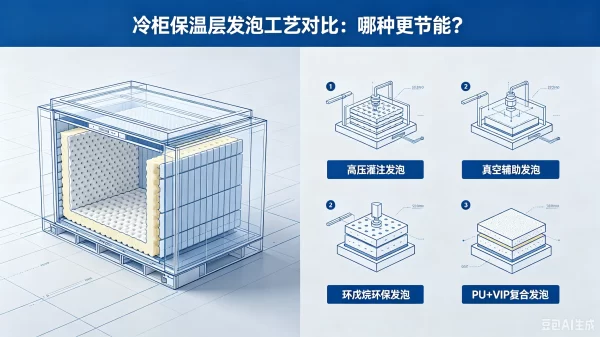
2. Technical Analysis of Mainstream Freezer Insulation Foaming Processes
2.1 High-Pressure Injection Foaming
Technical Principle
High-pressure injection foaming is a traditional mainstream process. A high-pressure foaming machine (100-200bar) accurately proportions and rapidly mixes combined polyether, isocyanate, foaming agent (cyclopentane/water), catalyst and other raw materials, injects them into the interlayer of the freezer box. The raw materials react and expand rapidly (expansion ratio 30-40 times), fill the cavity and solidify to form a rigid foam layer.
Core Characteristics
- Cell structure: average pore size 180-220μm, closed-cell rate 92%-94%, density 38-42kg/m³;
- Thermal conductivity: 0.022-0.025W/(m·K) (-25℃ working condition);
- Process advantages: mature equipment, low cost, high production efficiency, suitable for mass production, strong structural adaptability, can fill complex cavities;
- Limitations: general cell uniformity, prone to local density deviation (±5%-10%), obvious thermal bridge effect, high energy consumption.
2.2 Vacuum-Assisted Foaming
Technical Principle
Vacuum-assisted foaming is an upgraded version of high-pressure injection. Before material injection, a vacuum system evacuates the air inside the box to -0.08~-0.1MPa to form a negative pressure environment; after injecting raw materials, negative pressure promotes material flow and filling, inhibits bubble merging and rupture, maintains vacuum during the reaction, and solidifies to form a high-density uniform foam layer.
Core Characteristics
- Cell structure: average pore size ≤100μm, closed-cell rate ≥96.5%, density uniformity deviation ≤±2%;
- Thermal conductivity: 0.018-0.020W/(m·K) (-25℃ working condition), 10%-15% lower than high-pressure injection;
- Process advantages: no dead corners in foam filling, weak thermal bridge effect, significantly improved thermal insulation performance, energy saving of 8%-10% under the same insulation thickness;
- Limitations: requires supporting vacuum equipment, high initial investment, slightly longer production cycle, strict requirements for equipment sealing.
2.3 Cyclopentane Eco-Friendly Foaming
Technical Principle
Cyclopentane eco-friendly foaming uses cyclopentane (GWP<1) instead of traditional high-GWP hydrofluorocarbons (HFCs) as the foaming agent, mixed with combined polyether, isocyanate and other raw materials for foaming. There is no Freon emission during the reaction, combining environmental friendliness and low thermal conductivity.
Core Characteristics
- Cell structure: narrow pore size distribution (standard deviation <35μm), closed-cell rate 95%-97%, density 36-40kg/m³;
- Thermal conductivity: 0.019-0.021W/(m·K) (-25℃ working condition), better environmental performance than traditional processes;
- Process advantages: low GWP complies with global environmental regulations (e.g. EU F-Gas Regulation), good foam stability, long-term thermal conductivity attenuation rate <3%;
- Limitations: cyclopentane is flammable and explosive, production requires explosion-proof workshops, high raw material cost, strict requirements for process safety control.
2.4 PU+VIP Composite Foaming
Technical Principle
Composite foaming is a high-end process. Vacuum Insulation Panel (VIP) covers large flat areas of the freezer (e.g. box side walls, doors), and polyurethane foaming fills complex structural areas such as corners and pipe interfaces, forming a composite insulation layer of “VIP main insulation + PU auxiliary filling” to maximize thermal resistance.
Core Characteristics
- Cell/structure: VIP thermal conductivity ≤0.005W/(m·K), PU foam closed-cell rate ≥95%, overall thermal conductivity of composite layer 0.012-0.015W/(m·K);
- Energy-saving effect: 20%-25% energy saving compared with single high-pressure injection foaming, compressor start-stop times reduced by 35%;
- Process advantages: extreme thermal insulation performance, suitable for ultra-thin box design, lowest long-term energy consumption, first choice for high-end commercial freezers;
- Limitations: high VIP cost, fragile, non-bendable, only suitable for flat areas, highest process complexity.
3. In-Depth Performance Comparison of Four Foaming Processes (With Optimized Supplements)
3.1 Core Performance Indicator Comparison Table (With Cost Magnitude)
| Process Type | Thermal Conductivity (W/(m·K)) | Closed-Cell Rate | Density (kg/m³) | Energy-Saving Efficiency (vs High-Pressure Injection) | Relative Initial Investment Cost | Relative Material Cost | Applicable Scenarios |
|---|---|---|---|---|---|---|---|
| High-Pressure Injection Foaming | 0.022-0.025 | 92%-94% | 38-42 | Benchmark (0%) | 1.0x (Benchmark) | 1.0x (Benchmark) | Household freezers, economy commercial freezers, mass production |
| Vacuum-Assisted Foaming | 0.018-0.020 | ≥96.5% | 38-40 | 8%-10% | 1.5-2.0x | 1.1-1.3x | Mid-to-high-end commercial freezers, EU/North American export models, energy-saving priority projects |
| Cyclopentane Eco-Friendly Foaming | 0.019-0.021 | 95%-97% | 36-40 | 5%-7% | 1.1-1.3x | 1.2-1.4x | Eco-friendly compliant models, global export freezers, low-carbon certified products |
| PU+VIP Composite Foaming | 0.012-0.015 | ≥95% (PU) | 34-38 | 20%-25% | 2.0-3.0x | 5-8x (VIP proportion) | High-end commercial freezers, medical refrigerators, ultra-thin energy-saving models |
Note: Cost data is calculated based on industry public equipment quotations and mainstream material procurement prices. The investment of vacuum-assisted foaming equipment is about 1.5-2 times that of high-pressure injection, and the cost of VIP materials is 5-8 times that of ordinary PU foam (converted by unit insulation effect).
3.2 Long-Term Thermal Insulation Stability Comparison (Aging Performance Supplement)
The design life of commercial freezer scenarios is usually more than 10 years, and the increase in thermal conductivity caused by foam aging is a key factor affecting long-term energy-saving effects:
- High-Pressure Injection Foaming: After 5-10 years of use, affected by moisture penetration and cell wall degradation, the thermal conductivity can increase by 15%-20% (from 0.024W/(m·K) to 0.028-0.029W/(m·K)), the closed-cell rate drops to 88%-90%, and the energy-saving effect attenuates by about 12%-15%;
- Vacuum-Assisted Foaming: High closed-cell rate (≥96.5%) effectively blocks moisture penetration. After 10 years of aging, the thermal conductivity increases by about 5%-8% (from 0.019W/(m·K) to 0.020-0.021W/(m·K)), and the energy-saving effect attenuation is controlled within 5%;
- Cyclopentane Eco-Friendly Foaming: The synergistic effect of low thermal conductivity foaming agent and stable cell structure makes the thermal conductivity increase <5% after 10 years of aging, and the performance stability is close to that of vacuum-assisted foaming;
- PU+VIP Composite Foaming: The aging characteristics of the PU part are consistent with cyclopentane foaming. If the VIP board uses high-quality barrier film and getter materials, the thermal conductivity increase caused by internal pressure rise after 10 years of use is about 3%-5% (from 0.004W/(m·K) to 0.005-0.006W/(m·K)), and the overall energy-saving effect attenuation is <8%.
3.3 Impact of Process Parameters on Mass Production Performance (Feasibility Supplement)
The theoretical energy-saving effect is significantly affected by the control level of process parameters in actual production. Even for the same process, the actual performance difference between different factories may exceed the theoretical difference between processes:
- High-Pressure Injection Foaming: Deviations in injection volume (±3%), mold temperature (±5℃), and raw material ratio (±1%) can lead to foam density deviation of ±10%, thermal conductivity fluctuation of ±0.003W/(m·K), and energy-saving effect deviation of up to ±8%;
- Vacuum-Assisted Foaming: Insufficient vacuum degree (>-0.07MPa) will cause the cell pore size to increase by 30%, the closed-cell rate to drop below 94%, the thermal conductivity to rise by 0.002-0.003W/(m·K), and the energy-saving effect to lose about 5%;
- Cyclopentane Eco-Friendly Foaming: Excessive moisture content in raw materials (>200ppm) will trigger additional reactions to generate CO₂, leading to cell rupture, closed-cell rate dropping below 93%, and thermal conductivity rising by 0.002W/(m·K);
- PU+VIP Composite Foaming: Improper control of VIP board installation gaps (>2mm) will form thermal bridges, leading to a 20%-30% increase in local heat flux density and a 3%-5% decrease in overall energy-saving effect.
3.4 Chain Impact of Foaming Process on Refrigeration System (System Energy Saving Supplement)
The performance of the insulation layer directly affects compressor selection and system load. Energy saving is not only reflected in the insulation layer itself, but also in the optimization of the whole machine system:
- Compressor Power and Start-Stop Frequency: Taking a 600L commercial horizontal freezer as an example, the high-pressure injection foaming model requires a 1/3HP compressor with a start-stop frequency of about 6-8 times/hour; the PU+VIP composite foaming model can use a 1/4HP compressor with a start-stop frequency reduced to 4-5 times/hour, extending the compressor life by about 20% and reducing annual maintenance costs by 15%;
- Condenser and Evaporator Load: For every 0.003W/(m·K) reduction in the thermal conductivity of the insulation layer, the condenser load can be reduced by 8%-10%, and the evaporator defrost cycle is extended by 30%-40%, reducing defrost energy consumption;
- Whole Machine Energy Consumption Measured Comparison: Under the working conditions of 35℃ ambient temperature and -18℃ internal temperature, the measured 24-hour power consumption of a 600L commercial horizontal freezer with different foaming processes is as follows:
- High-Pressure Injection Foaming: 2.8-3.2kWh/24h;
- Vacuum-Assisted Foaming: 2.5-2.7kWh/24h (about 10% energy saving);
- Cyclopentane Eco-Friendly Foaming: 2.6-2.8kWh/24h (about 7% energy saving);
- PU+VIP Composite Foaming: 2.1-2.3kWh/24h (about 25% energy saving).
4. Process Selection Recommendations and Industry Trends
4.1 Scenario-Based Selection Recommendations (With Full Life Cycle Perspective)
| Application Scenario | Core Requirements | Recommended Process | Key Considerations |
|---|---|---|---|
| Economy Household Freezers | Cost priority, basic energy efficiency | High-Pressure Injection Foaming | Low equipment cost, high mass production efficiency, need to control process parameter fluctuations to reduce performance deviations |
| Export EU/North American Models | Environmental compliance, energy efficiency standards | Cyclopentane Eco-Friendly Foaming | Meet low-GWP regulations, better long-term stability than traditional foaming agents, suitable for global market certification |
| Mid-to-High-End Commercial Freezers | Energy efficiency priority, full life cycle cost | Vacuum-Assisted Foaming | 8%-10% energy saving, initial investment can be recovered through 5-7 years of electricity bill savings, need to support stable vacuum system |
| Medical/Ultra-Thin High-End Models | Extreme thermal insulation, space utilization | PU+VIP Composite Foaming | 20%-25% energy saving, need to control VIP installation gaps and transportation protection to avoid damage and failure |
4.2 Industry Development Trends
- Micronization and Low Thermal Conductivity: Foaming processes develop towards pore size <80μm, closed-cell rate >97%, thermal conductivity <0.018W/(m·K). The application of nano infrared opacifiers can further inhibit radiation heat transfer, reducing thermal conductivity by 10%-15%;
- Accelerated Eco-Friendly Substitution: Low-GWP foaming agents such as cyclopentane and isobutane fully replace HFCs. All-water foaming technology achieves closed-cell rate improvement through catalyst optimization, balancing environmental friendliness and energy saving;
- Popularization of Composite Processes: The cost of PU+VIP composite foaming gradually decreases with large-scale production, and its penetration rate in mid-to-high-end commercial freezers increases. At the same time, multi-layer composite schemes such as “VIP + aerogel + PU” appear to further optimize corner thermal bridges;
- Digital Precision Control: MES systems and AI algorithms are applied to foaming injection control, realizing closed-loop control of injection volume, mold temperature and vacuum degree, with density deviation controlled within ±1%, improving mass production performance consistency.
5. Conclusion
The core of energy saving in freezer insulation foaming processes lies in cell structure optimization, density uniformity improvement, low thermal conductivity material composite application and long-term stability control. Among the four mainstream processes, PU+VIP composite foaming has the optimal energy saving (20%-25%) but the highest cost, suitable for high-end special scenarios; vacuum-assisted foaming (8%-10%) offers outstanding cost-performance, balancing long-term stability and mass production feasibility; cyclopentane eco-friendly foaming (5%-7%) adapts to global environmental trends and is the preferred solution for export models; high-pressure injection foaming has the lowest cost and meets basic needs, but it is necessary to strictly control process parameters to reduce performance deviations.
Freezer manufacturers and component suppliers need to select processes based on target market energy efficiency standards, cost budgets, environmental requirements and mass production control capabilities, while paying attention to the chain impact of processes on the refrigeration system to achieve whole machine system energy saving rather than single component optimization. In the long run, micronization, eco-friendliness, composite technology and digitalization will become the core development directions of foaming processes, promoting the freezer industry to achieve coordinated development of “high efficiency and energy saving, low carbon and environmental protection, cost controllability and long-term stability”.